
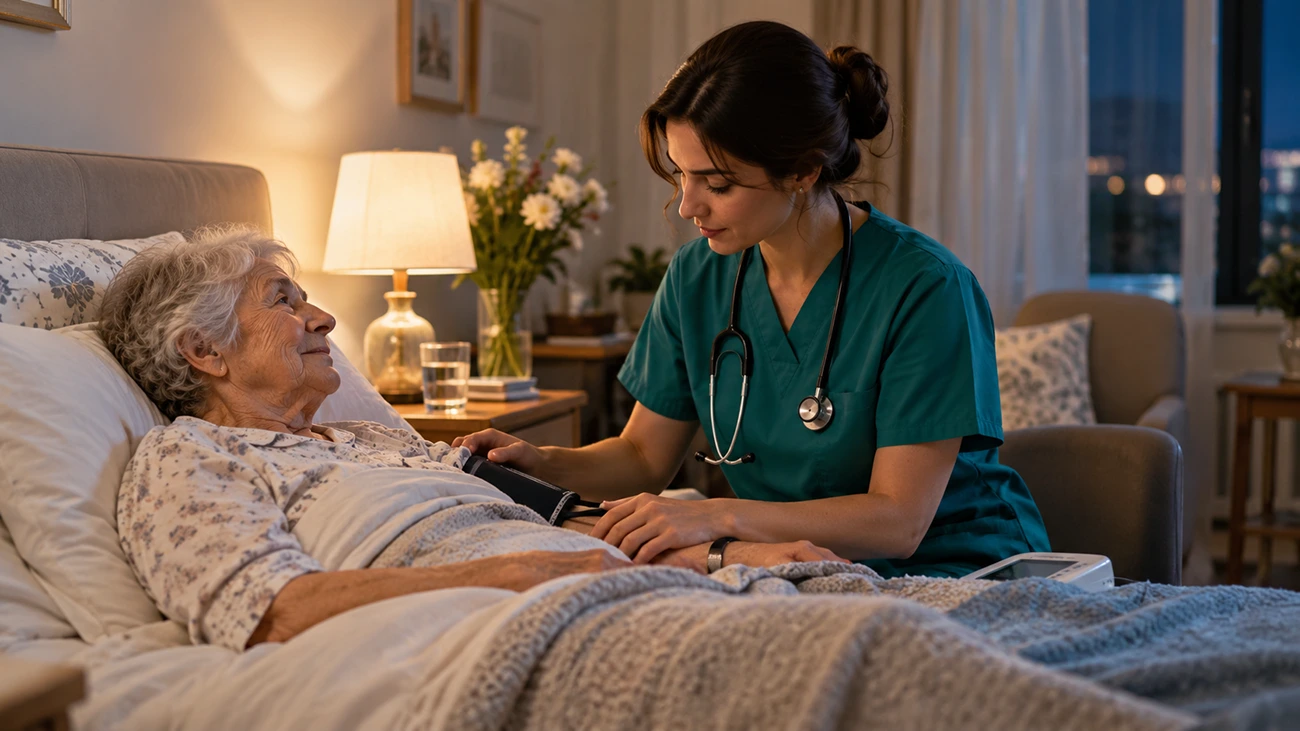
Sometimes a patient needs more than a one-time procedure. There are situations where a person does not only need an injection, IV infusion, or wound dressing, but also continuous observation, daily assistance, hygiene support, medication control, and properly organized care. In such cases, 24-hour nursing care at home may be needed.
This type of care is especially important for elderly patients, people recovering after surgery, patients with severe chronic conditions, bedridden patients, and situations where family members cannot stay with the patient continuously.
NMS 24/7 — Your Family Nurse provides continuous nursing support at home, based on the patient’s condition, medical recommendations, and family needs.
What does 24-hour nursing care mean?
24-hour nursing care means that a nurse or trained healthcare caregiver stays with the patient during the day or night, observes their condition, assists with daily care, and performs doctor-prescribed nursing procedures when needed.
This is not simply “being near the patient.” Proper continuous care includes regular assessment, organized support, hygiene, early recognition of risks, and clear communication with family members.
Who may need continuous nursing support?
Continuous nursing care may be needed when the patient has mobility difficulties, weakness, a post-surgical recovery period, rehabilitation after stroke or trauma, chronic illness, palliative needs, or bedridden status.
It may also be important when the patient needs night supervision, regular help with movement, eating, hygiene, or following a medication schedule.
What is included in continuous nursing care?
Continuous nursing care may include several types of support. The exact plan is always created individually, according to the patient’s condition.
It may include:
- monitoring the patient’s general condition
- checking temperature, blood pressure, pulse, and other indicators
- following the doctor’s instructions
- supervising medication timing
- assisting with personal hygiene
- changing bed linen and keeping the bed clean
- helping with feeding
- assisting with movement
- preventing pressure sores
- monitoring wounds or dressings
- observing catheters, feeding tubes, or other medical needs
- informing family members about the patient’s condition
Any medical procedure should be performed only according to a doctor’s prescription or relevant medical recommendation.
Why is continuous observation important?
In elderly, weakened, or post-surgical patients, the condition may change quickly. Sometimes an important warning sign begins with a small detail — fever, blood pressure change, wound irritation, changes in urination, reduced appetite, confusion, or general weakness.
Regular observation by a nurse helps the family notice changes earlier and contact a doctor when necessary. This is especially important when the patient cannot clearly describe how they feel or when family members do not have medical experience.
24-hour care and family support
Continuous care is not only support for the patient. It also reduces the physical and emotional burden on family members. When a patient needs night supervision, frequent repositioning, hygiene support, or constant attention, the process can become exhausting for the family.
Professional nursing support helps make care more organized, safer, and calmer.
How is nursing care planned?
Before starting care, it is important to assess the patient’s condition, diagnosis, mobility, nutrition, hygiene needs, doctor’s instructions, and family expectations.
After that, the most suitable format can be selected: full 24-hour care, night duty, daytime care, hourly assistance, or periodic visits. Choosing the right format ensures that the patient receives the exact level of support they need.
NMS 24/7 approach
At NMS 24/7, every case is considered individually. Our goal is to create a safe, clean, caring, and stable environment for the patient.
Our team pays special attention to hygiene, timely response, communication, patient dignity, and correct implementation of medical recommendations.
Conclusion
24-hour nursing care is needed when the patient requires not a single procedure, but continuous support, observation, and daily assistance. Properly organized care reduces the family’s burden and allows the patient to receive support at home, in a familiar and calm environment.
NMS 24/7 — continuous nursing care at home, adapted to the patient’s needs.